
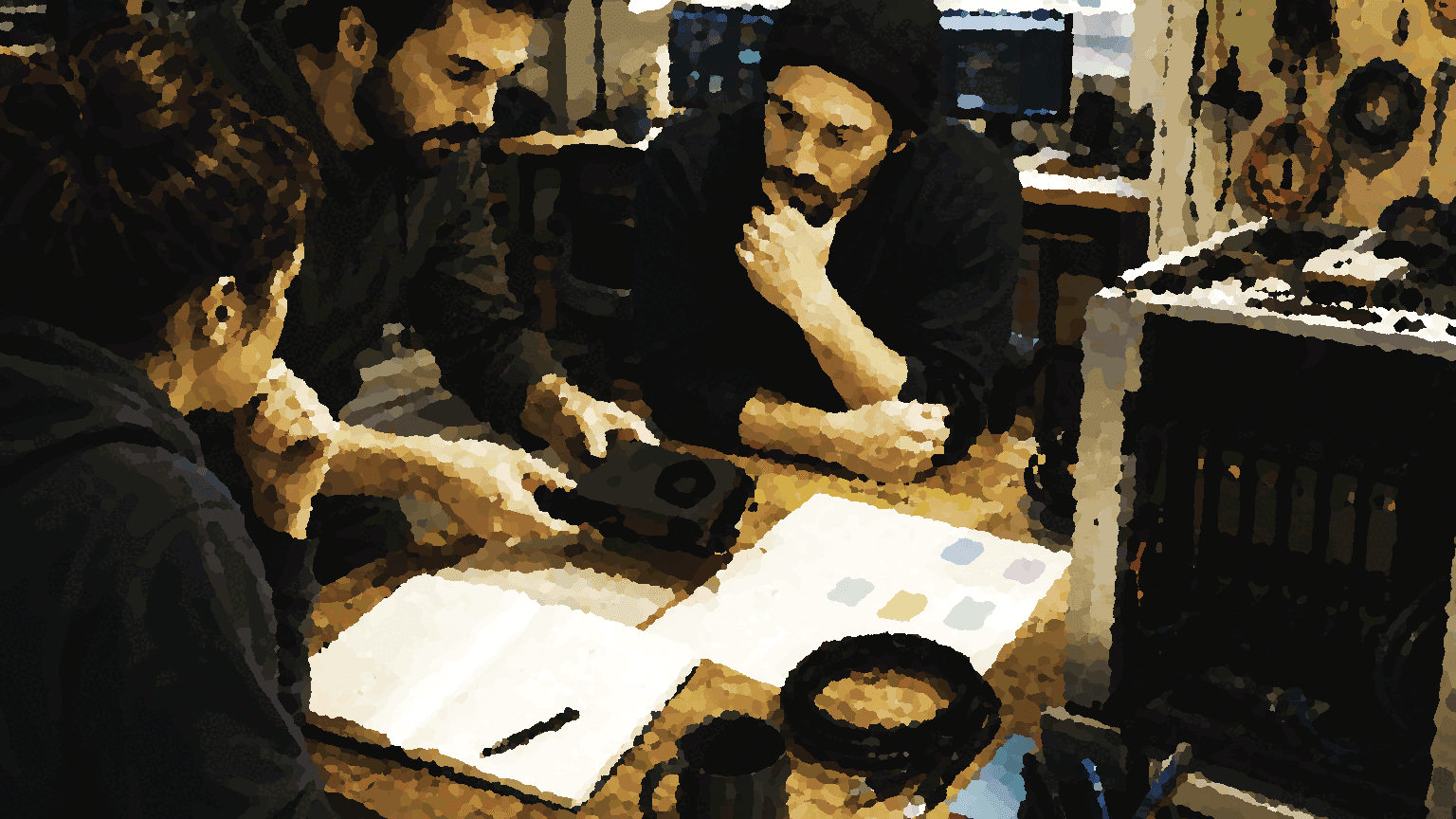
What happens when a bootstrapped AI startup stops treating cloud GPUs as the default, spends 18 months turning scattered infrastructure experiments into a local GPU base layer, and still keeps frontier models on tap? You get melted credit cards, BIOS voodoo, a few very loud fans, and a lesson that could save your runway.
The invoice crossed into five figures.
In our case, it was about $16,000.
For dev workloads.
That was the moment our “cloud-first” AI startup had to admit the obvious: the economics no longer made sense.

Last year, I circulated an early version of this story to a few advisors. The feedback was encouraging, but the draft was still too much “look at the rack” and not enough “here is the decision framework.” By February, the infrastructure had started coming together in a way that changed our pace, confidence, and product momentum.
This was not a weekend hardware experiment.
It was an 18-month infrastructure journey: from cloud-only prototypes, to desktop GPU towers, to a garage cluster, to a rack-mounted hybrid AI stack that started turning into real operating leverage in February. The shape was finally right: predictable workloads on owned hardware, with frontier models from OpenAI, Anthropic, and others still available when they were the right tool.
The lesson was not “cloud bad, on-prem good.”
The lesson was sharper:
For AI startups, infrastructure is product strategy.
Your infrastructure mix shapes your cost structure, latency, privacy posture, product ambition, and how far you can push before the token meter, GPU rental bill, or runway reality starts screaming.
The short version
After our cloud GPU run rate crossed into five figures for dev workloads, we moved predictable AI workloads onto owned hardware and kept the cloud for burst capacity and frontier reasoning.
- Own the base. Rent the frontier. Put predictable, privacy-sensitive workloads close when utilization justifies it; keep burst and frontier reasoning in the cloud.
- Utilization beats unit price. If GPU usage is sporadic, cloud wins. Around 40% of a 24/7 cycle, ownership starts to become very interesting.
- Hybrid is the sane middle. The future is not ideological. It is workload routing.
- Break-even looked roughly like months 3–4 in our model. The investment was about $44K–$51K against a roughly $16K/month cloud run rate, depending on what we counted.
- Year-one all-in savings were roughly 73% in that internal model. The comparison was about $192K cloud-only versus about $51K all-in local/hybrid base cost.
- MVE beats MVP. The point was building a Minimum Valuable Experience users would actually miss if it disappeared.
This was never just a cost optimization story. It was about creating the infrastructure conditions for a better product.
February was the turning point: faster iteration, fewer cost shocks, and more confidence to test the AI experience we wanted users to feel.
Why we did not stay cloud-only
Sociail is building a human-first, AI-native collaboration platform where humans and AI participants work together in shared spaces.
That creates a mixed workload: routine inference, retrieval, experimentation, routing, frontier reasoning, privacy-sensitive workflows, and burst capacity for demos, launches, and spikes.
A cloud-only approach made sense at the beginning. It let us move quickly, test ideas before committing to hardware, and avoid operational burden while the product direction was still forming.
But cloud-only started to break down once usage became less experimental and more persistent. The painful part was not only the total spend; it was the unpredictability.
One heavy week of dev testing could make the bill jump. One “let’s try this one more way” moment could turn into real money.
That is fine when you are validating a direction. It is dangerous when you are trying to build a repeatable product experience as a bootstrapped startup.
The real question: what experience are we trying to deliver?
The cloud versus on-prem debate usually gets framed as CapEx versus OpEx.
That framing is too narrow.
The better question is:
What infrastructure mix lets us deliver an experience users would genuinely miss if it disappeared?
That is what I mean by Minimum Valuable Experience.
An MVP proves something can work.
An MVE proves something is valuable enough to matter.
For Sociail, the MVE required:
- collaboration that feels responsive enough to stay in flow
- AI assistance that does not feel like a bolted-on chatbot
- self-hosted capacity for predictable and privacy-sensitive workloads
- frontier model access when deeper reasoning is worth the cost
- enough cost control to keep improving the product without watching the runway melt
If infrastructure makes the experience too slow, too expensive, too fragile, or too constrained, it becomes a product issue.
The 18-month path: from rented GPUs to owned base layer
This did not happen in one heroic weekend.
It started with the obvious thing: use the cloud. Then came the first local GPU tower. Then two. Then four. Then a rack. By February, hardware, networking, Kubernetes, model routing, and deployment flow began acting less like separate projects and more like one system.
| Period | Milestone | What we learned |
|---|---|---|
| Early cloud phase | Cloud-only prototypes | Great for speed, dangerous once usage becomes persistent |
| First local tower | Single desktop GPU sandbox | Local inference and fine-tuning could pay for itself quickly |
| Garage cluster | Multiple GPU towers | Useful, but messy: thermals, networking, power, and management overhead add up |
| Rack build | Refurbished Dell servers plus L40/T4 GPUs | Real capacity requires boring infrastructure discipline |
| February inflection | Local rack, K3s, routing, and deployment patterns started coming together | Once infrastructure becomes coherent, product momentum compounds |
| Hybrid mesh | Owned base layer plus frontier APIs | The winning move is routing workloads, not choosing a religion |
The emotional arc was familiar to anyone who has built infrastructure too early, too late, or under pressure. First, cloud feels like freedom. Then the bill starts looking like rent on a second office. Then hardware feels like control.
Then hardware reminds you that control comes with BIOS updates, cabling, thermals, monitoring, network weirdness, and very physical consequences. Once enough of it works together, progress compounds because every experiment no longer starts from zero.
The trick is not to avoid pain.
The trick is to choose the pain that gives you leverage. February was when that leverage finally became visible.
The hardware stack
By February, the core rack was built around refurbished enterprise hardware and a practical GPU mix.
| Qty | Component | Key specs | Why it mattered |
|---|---|---|---|
| 4 | Dell PowerEdge R740xd | Dual Xeon, high RAM, NVMe, 10 GbE | Plenty of PCIe, memory, and storage flexibility |
| 2 | NVIDIA L40 Ada | 48 GB VRAM each | Heavier local inference, multimodal, and fine-tuning experiments |
| 4 | NVIDIA T4 | 16 GB VRAM each | Efficient always-on inference and utility workloads |
| 1 | NAS | Shared snapshot/storage layer | Off-cluster backup and data movement |
| 1 | 10 GbE switch | SFP+ fabric | Basic high-speed data backbone |
Total local VRAM in this initial rack profile: about 160 GB.
Not hyperscaler scale.
But enough to change the economics and product cadence of a small AI startup.
The rack did not replace frontier models. It gave us a local base layer.
That distinction is the whole strategy.
Why we moved from Proxmox to K3s
We tried Proxmox first. It is good software: convenient GUI, useful ZFS support, manageable GPU passthrough. For many homelab and virtualization use cases, it is a strong choice.
But for us, it created a second operating model. Our cloud environments already used Kubernetes patterns, GitHub Actions, Helm, and environment-based deployment flows. Recreating a parallel world in Proxmox meant more context switching, more one-off scripts, and more places for human error.
The real question became:
Why are we building a different deployment universe for the local rack?
So we wiped the nodes and moved to K3s.
One control-plane model. One deployment pattern. One mental model for DEV, STAG, PROD, and local infrastructure.
The least glamorous lesson may be the most useful:
The best infrastructure choice is often the one that reduces the number of worlds your team has to keep in its head.
The hybrid mesh: own the base, rent the frontier
The final architecture is not cloud-only and not on-prem-only. It is a hybrid mesh.
| Workload | Preferred home | Why |
|---|---|---|
| Routine AI collaboration | Local GPU base layer | Predictable usage, low marginal cost, privacy control |
| Domain RAG and retrieval-heavy flows | Local/hybrid | Fast iteration, controllable data path |
| Frontier reasoning | External frontier APIs | Use the best available models when they matter |
| Bursty experiments | Cloud | Do not buy hardware for occasional spikes |
| Large one-off jobs | Cloud or specialized rental | Better to rent unusual capacity than overbuild |
| Privacy-sensitive experiments | Local | Keep more control over data and runtime behavior |
Hybrid is not compromise. Hybrid is workload routing: use owned capacity for predictable base load and cloud capacity when the moment justifies it.
The practical version is simple:
Route the workload to the place where cost, latency, capability, and control make the most sense.
That is much more useful than arguing whether “the future is cloud” or “the future is local.”
For AI workloads, the future is routing.
When on-prem starts making sense
Here is the decision framework I wish I had earlier.
1. Check utilization
If your GPU usage is occasional, stay cloud-first.
If your usage is steady, recurring, and predictable, start modeling ownership.
A simple rule of thumb:
| Utilization | Recommendation |
|---|---|
| 0–20% | Stay cloud-only |
| 20–40% | Explore hybrid |
| 40%+ | Seriously model owned hardware for base workloads |
This is not a law of physics. Power costs, hardware availability, team skill, and workload type matter. But as a founder heuristic, it is useful.
2. Separate base load from burst load
Do not buy for the worst spike. Buy for the base. Rent for the spike.
3. Know whether latency matters
Some workloads tolerate delay. Some do not. For collaborative AI, latency is not a vanity metric. It affects whether people stay in flow.
But define latency honestly. Retrieval latency, first-token latency, full-answer latency, and user-perceived latency differ.
Our local stack made the most sense for predictable low-latency flows, not for pretending we could match every frontier model locally.
4. Count operational skill as a cost
Hardware is cheaper only if you can operate it. Someone has to understand power, thermals, networking, firmware, drivers, Kubernetes, storage, backups, monitoring, and recovery.
If your team cannot support that, the cloud premium may be worth paying.
Owned hardware gives you control. It also gives you the privilege of being the person who gets paged by a fan curve.
The economics: what actually changed
The comparison is imperfect but useful. These are our internal field-note numbers, not a benchmark or recommendation to copy the build.
| Year-one cost | Cloud-only | Local/hybrid base layer | Notes |
|---|---|---|---|
| Annualized cloud GPU/dev ops | ~$192,000 | Reduced dramatically | Based on a roughly $16K/month cloud run rate |
| Core servers and GPUs | $0 | ~$44,000 | Core compute investment |
| Full supporting rack environment | $0 | ~$51,400 | Includes supporting gear, electricity/cooling assumptions, networking, recovery assumptions |
| Practical break-even | — | Roughly months 3–4 | Depends on what CapEx scope is counted |
| Year-one total comparison | ~$192,000 | ~$51K | Roughly 73% lower all-in year-one base cost in this internal model |
The point is not that everyone should copy these numbers. You probably should not.
Your power costs, hardware availability, team, workload, financing, and risk tolerance will be different.
The point is that once usage becomes predictable, the economics can flip fast.
Cloud is wonderful for optionality. It is expensive for steady waste.

Hard-earned lessons
Expensive lessons are obvious in hindsight.
Utilization beats unit price
A cheap hourly GPU can still be expensive if you need it all the time.
An owned GPU can be expensive upfront and cheap over its useful life. The question is not price per hour in isolation. The question is utilization over time.
Do not build two operational worlds
If your production path is Kubernetes, be careful about creating a local environment that behaves nothing like it.
The cost is not only technical. It is cognitive. Small teams cannot afford too many mental models.
Thermals and power are product risks
A GPU spec sheet does not tell you what happens inside your rack, in your room, with your airflow, on your power circuit, under your workload.
Thermals lie until they do not. Power margins matter. Cable management is not cosmetic.
Used enterprise hardware is both gift and trap
Refurbished servers can be incredible value, but they come with firmware archaeology, undocumented dependencies, and the occasional “why is this error happening only on Tuesdays?” moment.
Budget time for BIOS and firmware updates.
That is not optional hygiene. It is stability work.
Network is the quiet bottleneck
The GPUs are more exciting, but the network often decides how useful the cluster feels. 10 GbE was a practical starting point, not a forever answer for heavier distributed workloads.
Hybrid requires discipline
A hybrid system can save money or create chaos.
The difference is routing rules.
Know which workloads belong local, which belong cloud, and which should be escalated to frontier models only when needed.
Without that discipline, hybrid becomes two bills and twice the complexity.
What I would do differently
I would still go hybrid, but I would name the workload split sooner.
I would define base versus burst earlier, model recurring usage earlier, avoid duplicating deployment patterns, and budget more time for firmware, power, and thermal stabilization.
I would also be clearer with myself that the goal was not to build a cool rack. The goal was to buy back product freedom.
That is what the hardware really did.
It gave us room to experiment without every run feeling like a meter was spinning. It gave us more control over privacy-sensitive workflows, a base layer for responsive collaboration, and a way to keep frontier APIs as premium tools instead of default cost centers.
The real moral
This is not a cloud versus on-prem manifesto.
Cloud still matters. Frontier APIs matter. Managed services matter. Elastic capacity matters. But for AI startups, the default assumption that everything should live in rented infrastructure deserves more scrutiny than it gets.
The real question is not:
Should we use cloud or owned hardware?
The real question is:
What infrastructure mix lets us deliver the Minimum Valuable Experience at a cost structure we can survive?
For Sociail, the answer became hybrid: owned hardware for the predictable base, cloud for frontier capability and burst, a common deployment model so the team does not split its brain, and a routing mindset so every workload does not get treated the same.
That is the lesson from an 18-month climb that finally started compounding in February.
Infrastructure is not just plumbing. For an AI company, infrastructure shapes the product. And if you are bootstrapped, it may also decide whether you get enough time to build the product users would actually miss.
If you are building an AI product, the answer will not be the same for every team. But the question is worth asking early:
What are you renting for convenience, and what should you own for leverage?