
AI made individual work faster.
It also made the team’s work easier to lose.
I have felt this myself building with AI across product, customers, operations, and strategy. The speed is real. So is the mess that appears when the work spreads across private AI tabs, private notes, private judgment, and private follow-up.
I have had days where the AI outputs were everywhere: the summary in one place, the draft in another, the decision in my head, and the actual customer concern half-buried in notes.
A founder comes out of a customer call and asks AI for a summary. A product lead asks another model for roadmap implications. An operator drafts a follow-up in a private thread. Each output may be useful. None of them are connected.
By the next day, the team has a clean email, a few notes, and several confident interpretations of what happened.
But the important parts are scattered.
What did the customer actually mean? Which assumption did the team accept? What did AI infer? What did a human correct? What was approved? What became the next step?
That is the collaboration gap AI has made impossible to ignore.
The problem with AI at work is not only that the model can forget. It is that the team forgets what happened around the model.
AI did not just expose a model problem. It exposed a team-memory problem.
A familiar failure
The failure usually does not look dramatic while it is happening.
Everyone is trying to help. The founder hears urgency in the customer's voice. The product lead hears a roadmap tradeoff. The operator hears a support risk. AI makes each piece move faster: summary, implications, draft, checklist, follow-up.
Then the handoff happens.
Someone asks, "Why did we promise that?" Someone else says, "I thought that was only a draft." A third person remembers a customer concern that never made it into the final note.
The answer is scattered.
Part of it is in the transcript. Part of it is in someone's memory. Part of it is in a private AI chat. Part of it is in a follow-up email. The official artifact looks clean, but the reasoning behind it is fragile.
That is the moment a shared AI workspace should exist for: not when the team needs another chatbot, but when the team needs the work to remain understandable after the meeting ends.
The value is not that AI said something. The value is that the team can still tell what happened.
Not to replace the humans in the room. Not to run the company through invisible agents. To keep the context, roles, corrections, decisions, and next steps visible enough that the team can trust the work later.
The missing shared layer
The missing layer is not more prompts. It is not more autonomous agents. It is not a prettier transcript.
It is shared context around the work.
In plain English: it lets the team understand what happened, improve it, approve it, and trust it later.
A Thought Mesh is not the work itself. It is the structure that keeps the work from disappearing into disconnected tabs, memories, and drafts.
The word "mesh" only matters if it points to behavior the team can actually see:
- the customer context is shared,
- the AI output is visible,
- the human correction is captured,
- the decision owner is named,
- the artifact survives the meeting,
- the follow-up step is approved before it moves,
- the team can return later and see why the work changed.
If those things are not true, "mesh" is just architecture language dressed up as strategy.
If they are true, the team gets something valuable: AI-assisted work that can be inspected, corrected, reused, and trusted without reconstructing the whole story from memory.
Why private AI tabs break teamwork
Private AI tabs are useful for individual thinking. They are weak foundations for team decisions.
This was less visible when AI was mostly a personal productivity tool. It becomes unavoidable when AI starts touching customer promises, product decisions, hiring, finance, support, and operations.
They hide too much:
- the source context that shaped the output,
- the prompt or instruction that framed the answer,
- the assumptions the model made,
- the human correction that improved it,
- the moment when a draft became a decision,
- the reason one next step was approved and another was not.
That hidden layer creates rework. It also creates risk. The team may move faster in the moment while becoming less sure about what it actually decided.
A team can move quickly for a few hours.
Then it can spend the next day reconstructing what happened.
Why did we tell the customer that? Which version of the plan did the advisor react to? Was this a model suggestion, a human decision, or a draft that accidentally became official?
That is the hidden cost of private AI work. The output gets faster, but the surrounding judgment gets harder to inspect.
For serious work, the answer is not enough. The team needs the path to the answer.
This is why "AI in the workflow" is not enough. The workflow has to preserve shared context.
What a useful mesh should prove
A useful Thought Mesh has four pieces:
- Shared context. People and AI support can see the relevant room history, files, decisions, and constraints.
- Role clarity. Each participant has a visible purpose: summarize, challenge, draft, inspect, plan, review, or approve when human authority is required.
- Durable artifacts. The result becomes a brief, plan, checklist, decision, or output the team can keep using.
- Bounded action. Follow-through is visible, approval-aware, and scoped to what the system can safely do.
That is the simplest test.
Not "How many agents are running?"
Not "How impressive was the generated answer?"
Not "Did the demo look smart?"
The better question is: "Can the team see the context, roles, corrections, artifact, approval state, and next step clearly enough to trust what happened?"
The roles have to be visible
Multiple AI roles are useful only when they represent different lenses.
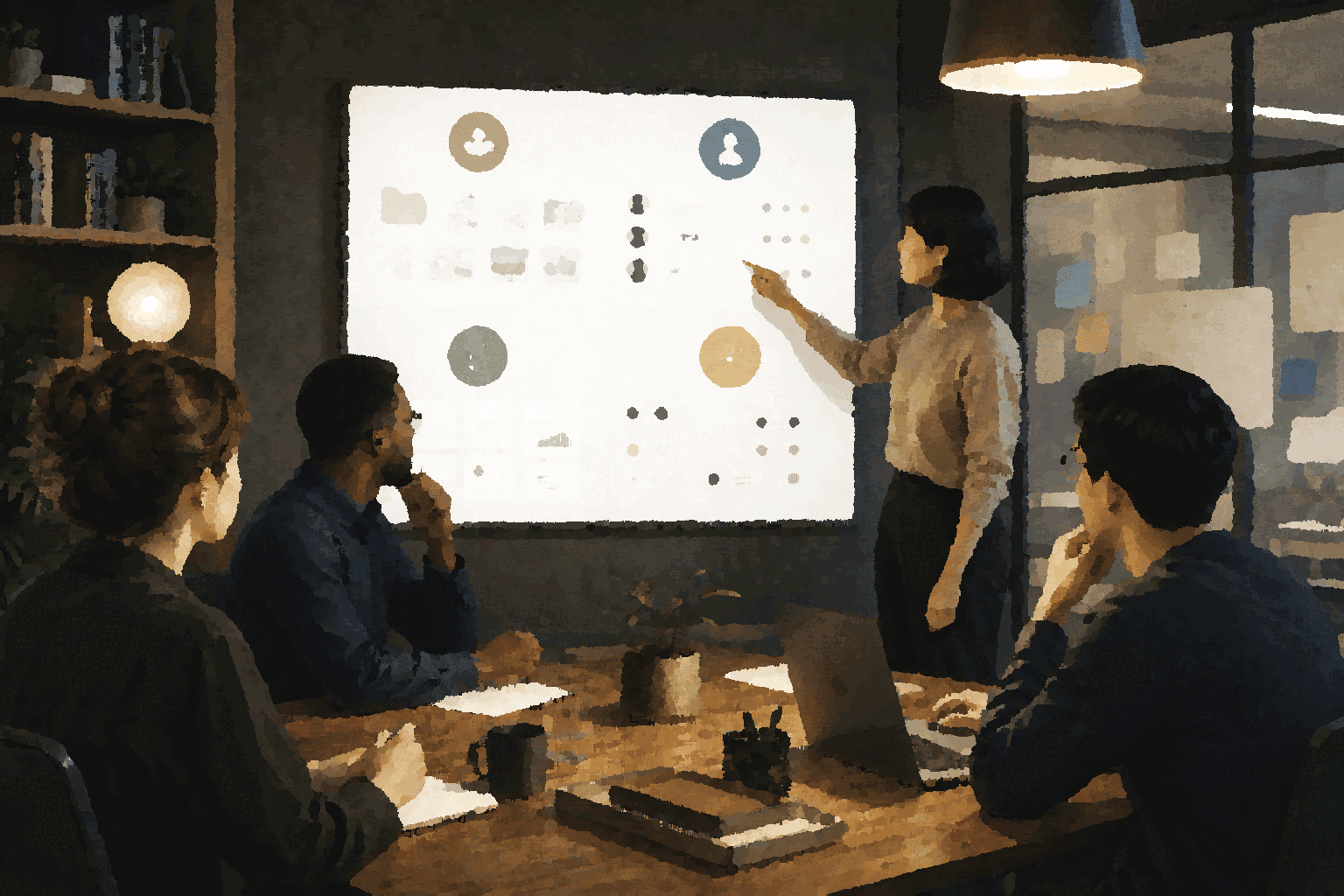
One AI role can summarize messy context. Another can challenge assumptions. Another can prepare an execution checklist. Another can inspect for trust or policy issues.
This is not magic. It is structured division of cognitive labor.
That distinction matters. Without visible roles, multiple AI outputs can become noise with different names. With visible roles, they become reviewable lenses on the same work.
The same is true for people. AI support can process context quickly, but it does not own the stakes. It does not carry the customer relationship, the company judgment, or the responsibility for what happens next.
People bring customer reality, founder judgment, taste, ethics, relationships, and responsibility. In a serious collaboration system, those human contributions should not be flattened into prompts or treated as minor edits on top of model output.
The work gets better when those roles reinforce each other: AI support preserving context and producing artifacts, humans correcting meaning and making accountable decisions.
That is why visibility matters. If the challenge role raises a concern, the room should see it. If the execution role proposes a next step, the team should approve it. If the summary misses the customer's real point, people should correct it.
The mesh should make reasoning visible, not mysterious. If AI support changes the work, the room should be able to see what changed and why.
The first useful version
A Thought Mesh does not need to be universal to be useful. In fact, the first useful version should probably be small.
The practical version can be narrow:
- A small team enters one room.
- The room has relevant messy context.
- An AI role helps turn that context into a decision brief.
- The brief names the owner, unresolved question, accepted assumption, and proposed follow-through step.
- A second perspective challenges or improves the brief.
- The team approves one bounded follow-through step.
- The output remains durable and inspectable.
That version is useful precisely because it stays small enough to inspect end to end. If the team cannot understand the context, the roles, the artifact, and the approved next step in one pass, the mesh is still too abstract.
That is the mesh working: not a swarm, not a buzzword, not a hidden automation layer, but a visible collaboration loop where the team can see the path from context to judgment to output.
In the better version of the same customer-call story, the summary is visible, the founder's correction is captured, the product concern is named, and the follow-up is approved before it goes out. A week later, the team does not have to reconstruct the decision from memory; the path from customer signal to approved action is still there.
A team can understand it in five minutes. More importantly, a team can return to it next week and still understand what happened.

Why this matters now
The market is full of diagrams about agents.
Some of that work is real and important. Better model orchestration matters. Better context engineering matters. Better tools matter.
But the best guidance keeps pointing in the same direction: simple workflows, clear boundaries, visible context, and human oversight matter more than impressive autonomy.
Anthropic's writing on effective agents, OWASP's GenAI risks, and the NIST AI Risk Management Framework all make the surrounding system hard to ignore when AI touches consequential work.
But teams do not experience the future of work as a diagram.
They experience it as the next customer call, the next decision, the next follow-up, the next moment where nobody is sure whether the context survived.
That is why the product story should stay concrete. A shared room. Visible AI participation. Human correction. A durable artifact. One approved next step. A record the team can return to without reconstructing the work from memory.
That is also why the human story matters. The future of AI collaboration will not be judged by how futuristic the diagram looks. It will be judged by whether real teams can use it when the work is messy, the context is incomplete, and the decision still matters.
The name matters less than the behavior.
If the behavior is real, "Thought Mesh" becomes a useful way to describe it. If the behavior is not real, the phrase should not be used.
The point
The future of AI collaboration is not just better prompts or more autonomous agents.
It is shared work where people and AI can reason from the same context, produce something that lasts, and move through next steps that stay visible and bounded.
That is the mesh worth building.
Not because the phrase is elegant.
Because the future of AI work is not just whether the model can answer.
It is whether the team can remember, inspect, correct, approve, and trust what happened next.