
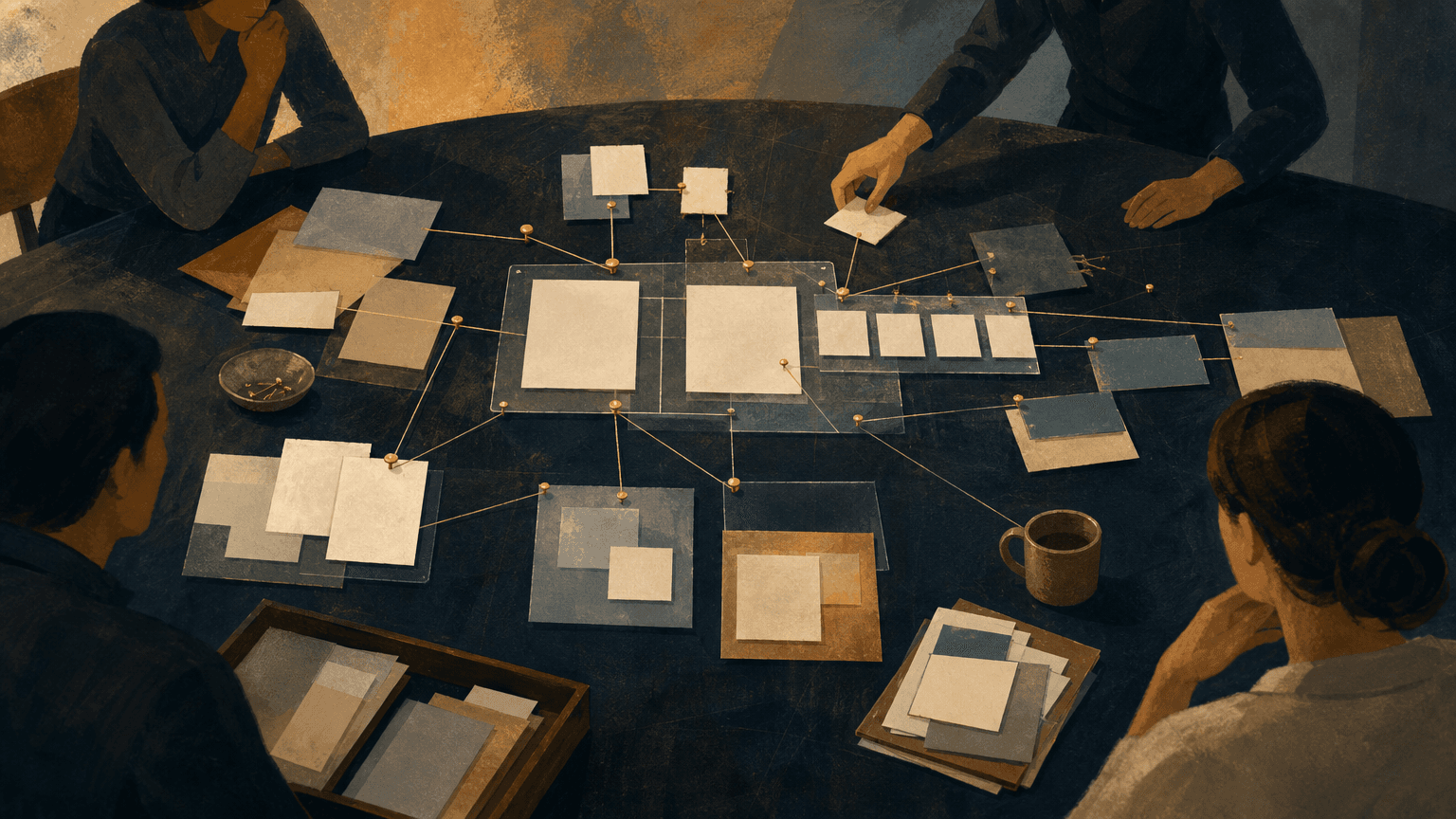
Companies were built, in part, because no single mind could hold the whole map.
We divided complexity into roles. Strategy over here. Engineering over there. Finance later. Security after the build. Customer experience somewhere between the promise and the support queue.
For most of modern company-building, distance was the organizing principle.
There was distance between the idea and the prototype. Distance between customer pain and product decision. Distance between the executive promise and the implementation reality. Distance between what leaders meant, what teams heard, what systems did, and what customers eventually experienced.
Some of that distance was necessary. Some of it was organizational gravity. Some of it was just friction wearing a respectable suit.
AI changes that.
Not by removing expertise.
Not by turning every founder into an engineer, every engineer into a lawyer, or every operator into a philosopher.
AI changes the shape of the organization because it shortens the path from question to consequence.
A founder can now move from market positioning to technical architecture to pricing mechanics to security posture to implementation ticket to investor narrative in one continuous working loop.
A customer request can imply a product promise, data model, permission question, support burden, compliance risk, and reusable operating pattern before the meeting is over.
This is not just productivity.
This is a cascade.

In brief
AI does not simply automate isolated tasks. It compresses the distance between strategy, implementation, security, finance, operations, customer experience, and accountability.
That compression can create better work when the relevant context stays visible. It can also create false confidence when every person accelerates inside a private AI thread and quietly builds a different version of the work.
The next advantage will belong to teams that can keep the cascade shared, inspected, and governed while work is happening, with one working version of record that leaders, engineers, security, sales, and operators can all draw from.
The old company was built on handoffs
The traditional organization is a chain of translation.
The executive frames the strategy. Product turns it into requirements. Design turns requirements into experience. Engineering turns experience into systems. Security reviews the systems. Finance asks what it costs. Operations asks how to support it. Legal asks where the company is exposed.
Then everyone discovers they were not talking about exactly the same thing.
That is not incompetence. It is the natural result of handoffs.
Every handoff loses signal. Every translation changes meaning. Every function sees a different slice of the object.
By the time the original idea becomes shipped reality, accountability becomes blurry.
Who owns the gap between what was intended and what was built?
Who owns the customer disappointment caused by a sales promise that engineering interpreted differently?
In the old model, the answer was usually political.
In the AI era, that answer is no longer good enough.
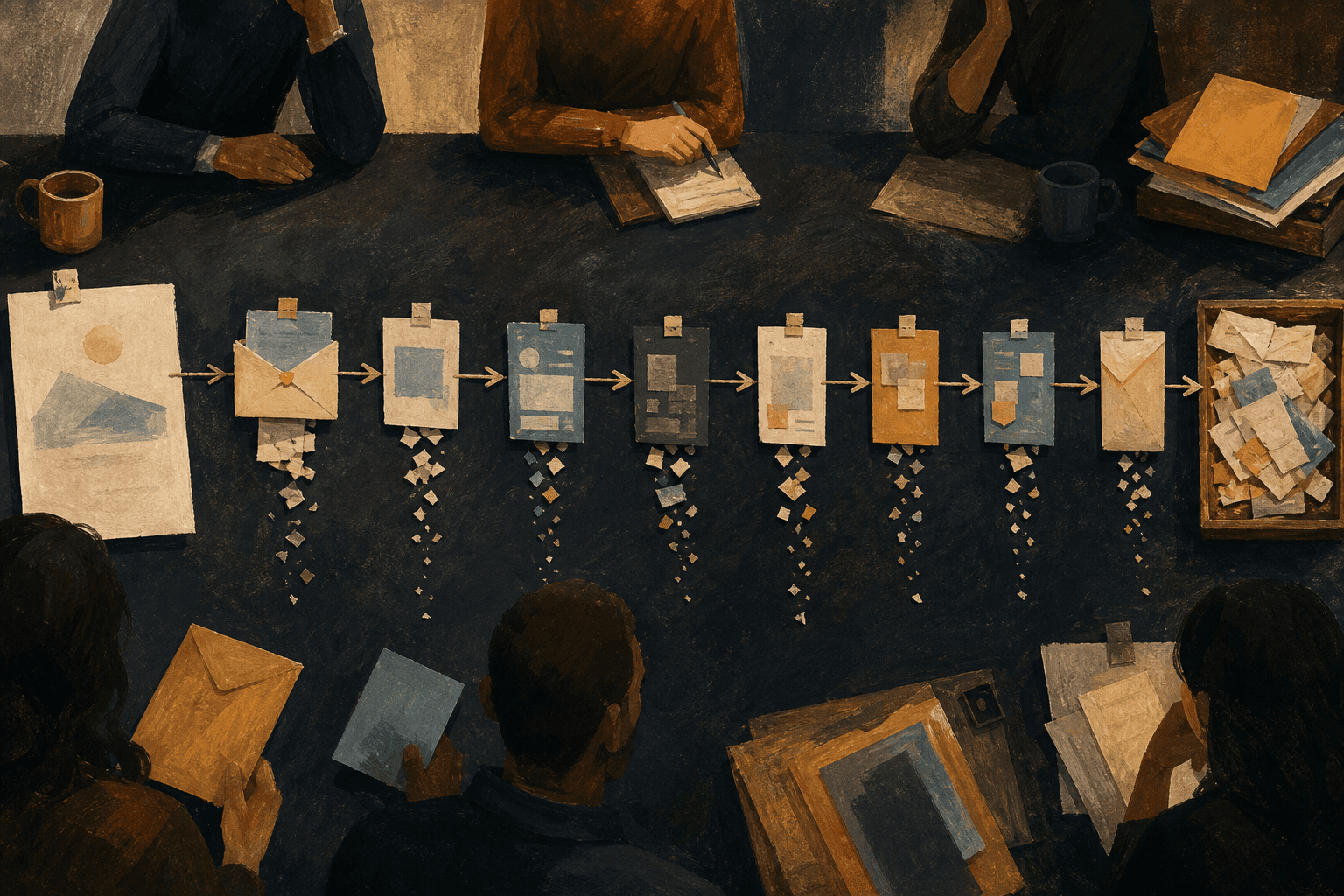
AI turns handoffs into loops
Well-designed AI workflows make it possible to keep multiple concerns in the same review loop.
A founder can ask: What is the product promise? What architecture would support it? What would make it secure? What would make it expensive? What would a customer misunderstand? What would break at scale? What should be written down as a decision?
That does not make the founder omniscient. It makes the founder less dependent on waiting for every concern to arrive through a separate meeting, document, or escalation path.
The point is not a smarter founder alone. The point is a faster first map.
The better the system, the more the work becomes a loop instead of a relay race. Strategy can talk to implementation, implementation to trust, trust to operations, and customer experience back to strategy.
That is the cascade.
What the cascade looks like in practice
A customer says they want an approval workflow for a sensitive process.
In the old model, that request might become a sales note, then a product ticket, then a design review, then an engineering estimate, then a security concern, then a pricing discussion, then a support burden. Each step would be understandable. Each step would also lose some of the original context.
In a compressed workflow, the request can be examined as one connected object:
- What promise are we making to the customer?
- What user roles and permissions are implied?
- What data becomes sensitive?
- What needs to be logged?
- What should require human approval?
- What happens if the AI suggests the wrong next step?
- What should become a reusable product pattern instead of custom work?
AI can help draft the follow-up, outline the proposal, generate the first product requirement, identify missing assumptions, suggest risk controls, and prepare the implementation brief.
But it should not silently turn the suggestion into a commitment.
The responsible version keeps the work in a shared room. The proposed promise, technical implication, approval path, customer expectation, and follow-through stay attached long enough for the right people to inspect them.
It also keeps a receipt: source context, assumptions, open risks, what was proposed, who approved it, what changed, and what still needs follow-through.
That receipt becomes the working version of record. Not perfect truth. Not the final answer forever. But a shared object the team can correct together instead of five private summaries competing for authority.
That is the difference between moving faster and moving responsibly at speed.
The founder as practical polymath, and the trap
Founders have always had to be generalists.
AI intensifies this.
It gives founders a way to move across infrastructure tradeoffs, legal language, UX flows, financial models, sales positioning, implementation tickets, investor narratives, and customer objections without waiting for every concern to be mediated by another person first.
This does not replace specialists.
It changes when specialists are needed and what they are needed for.
The specialist is no longer only the translator of a domain. The specialist becomes the validator, challenger, deepener, and risk owner.
The founder can arrive with a more complete first pass. The engineer can spend less time decoding vague intent. The lawyer can review clearer assumptions. The security expert can see the threat surface earlier.
That is the positive version.
The dangerous version is that AI can make a founder feel like a polymath before they have earned the judgment of one.
A model can explain Kubernetes, SOC 2, pricing strategy, OAuth, customer segmentation, cap tables, clinical privacy, and product onboarding in the same afternoon.
That does not mean the founder understands all of them well enough to make irreversible decisions.
Compression is not mastery. Fluency is not competence.
AI should help a founder see more of the system. It should not convince the founder that nobody else needs to see it.
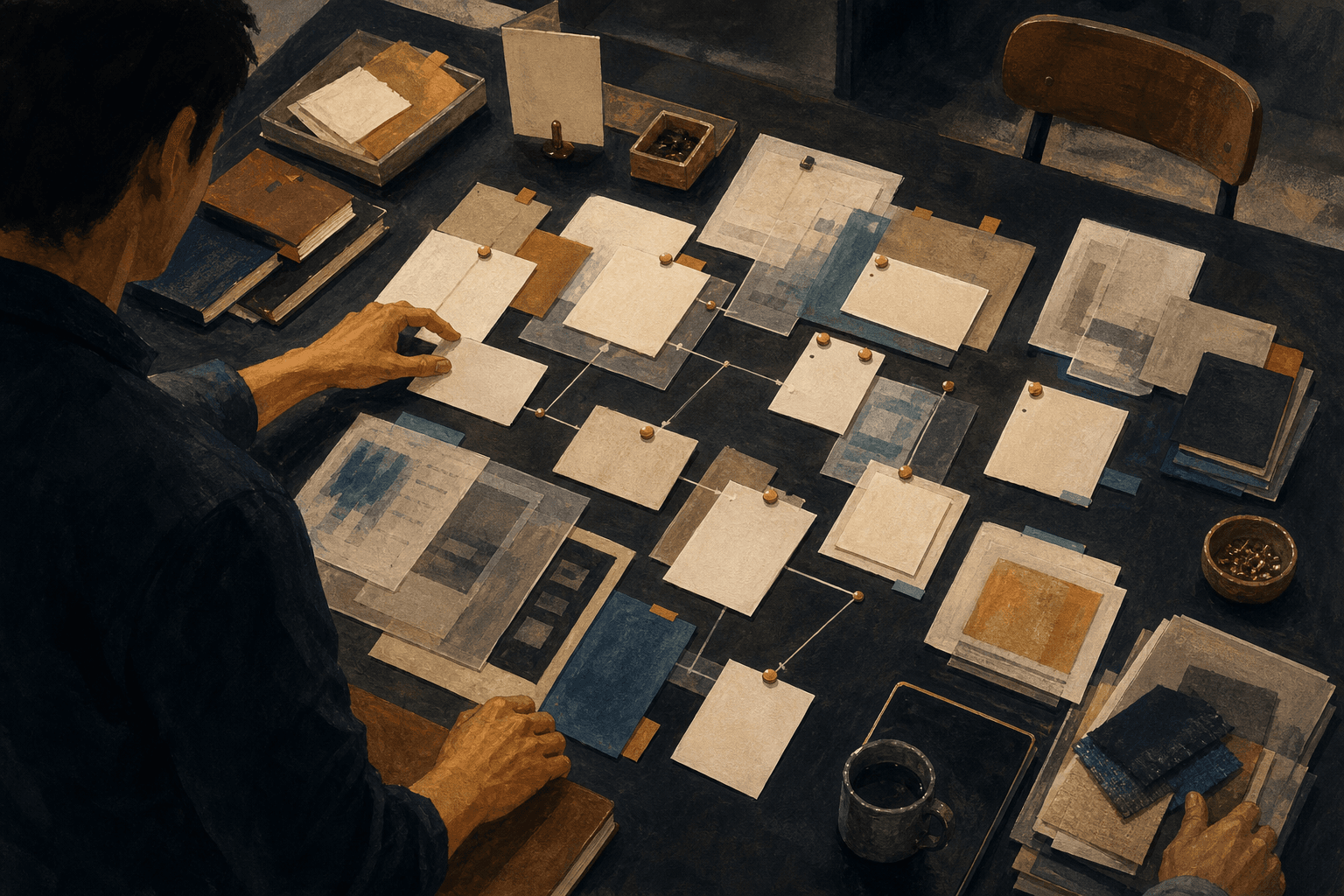
Responsibility moves upstream
One of the most important effects of AI is that it reduces the plausible distance between executive intent and engineering reality.
In the old world, an executive could say, “I asked for the product, not the vulnerability.” An engineer could say, “I built what was requested.” A product manager could say, “Security was out of scope.” A customer could say, “I thought you meant this worked differently.”
Everyone could be partly right and still collectively wrong.
Well-designed AI workflows can make that less defensible.
If the workflow can surface security implications during product planning, then security is not purely downstream. If it can compare implementation tradeoffs during strategy discussions, then engineering reality is not hidden. If it can simulate customer confusion before launch, then ambiguity is not invisible.
The gap between accountability and responsibility starts to close.
Accountability asks who is answerable after the fact.
Responsibility asks what should have been designed into the work before the fact.
Good AI workflows move responsibility upstream.
That is uncomfortable.
It should be.

Leaders and builders move closer to the work
Executives do not need to become full-time engineers. But they can no longer hide behind total abstraction.
In an AI-enabled organization, a leader can ask better questions earlier: What hidden technical debt does this strategy create? What user data is involved? What are we pretending is simple? What does engineering need us to decide before they build?
The best leaders will not use AI to bypass their teams. They will use AI to show up with better questions, clearer context, and fewer lazy abstractions.
The collapse goes both ways.
Engineering teams can no longer treat business context as someone else’s vague problem. AI can help engineers see customer goals, pricing implications, legal concerns, and executive priorities earlier.
That does not mean engineers become marketers. It means implementation can stay closer to purpose.
A technical decision is rarely only technical. A caching layer is a cost decision, a reliability decision, a product experience decision, and sometimes a trust decision. A data model is not just a schema. A permission system is not just backend logic. It is the company’s values expressed in code.
Well-designed AI support can surface those connections earlier because each role can see the same object from a different angle. The leader sees the promise. The engineer sees the implementation cost. The security lead sees the threat surface. The operator sees the support burden. The customer team sees the expectation being created.
That is good.
It is also demanding.
Shared intelligence needs a working version of record
The cascade becomes dangerous if it happens only inside private AI threads.
A founder has one conversation with AI. A backend engineer has another. A designer has another. A salesperson has another.
Each person moves faster.
The company may still become less aligned, because each person now has a faster private version of the work.
The leader has one summary. Engineering has another. Security has another. Sales has another. Operations has another. Each may be reasonable. Together, they may describe five subtly different companies.
The danger is not that people use AI. The danger is that everyone uses AI in a room nobody else can see.
The organization needs a place where the cascade can be seen, challenged, remembered, and turned into durable work. It needs a shared version of record: the source context, assumptions, decisions, risks, owners, approvals, and follow-through that every role can inspect.
Where the product decision keeps its security concerns attached.
Where the revenue idea keeps its operational implications attached.
Where the engineering tradeoff keeps its customer impact attached.
Where the founder’s instinct can be tested against team knowledge.
Where AI-assisted insight does not vanish into one person’s chat history.
The practical test is simple: when five people use AI on the same customer request, does the company end up with five private summaries, or one working version of record the team can inspect and correct?
That is the collaboration layer. It does not erase disagreement. It gives disagreement somewhere to land.
Shared intelligence turns the cascade into leverage
A cascade without a version of record drifts toward chaos. A cascade with shared intelligence becomes leverage.
It helps teams keep more of the system visible at once: strategy connected to implementation, implementation connected to trust, trust connected to user experience, operations connected to cost, and product ambition connected to customer value.
The goal is not to make every person responsible for every detail. The goal is to make the right concerns visible early enough that people can act responsibly.
That is why shared intelligence cannot be just another AI chat interface.
A room should not only contain messages. It should contain the evolving relationship between intent, context, constraints, artifacts, decisions, memory, roles, and follow-through.
That points to a different product surface: shared rooms where people, AI participants, artifacts, permissions, approvals, and receipts stay together.
The room is not only where the team talks. It is where the cascade becomes visible enough to govern.
Less relay race. More shared cockpit.
Less “throw it over the wall.” More “bring the wall into the room.”

That is how AI becomes useful to teams: not as an oracle, not as a shortcut around expertise, and not as a private sidecar for each person, but as a shared intelligence layer where the work can be accelerated, inspected, remembered, and owned.
The new founder advantage
The next founder advantage will not be only speed. Speed is table stakes.
The advantage will belong to founders and teams who can see connections earlier, preserve context better, and move responsibility upstream before execution outruns judgment.
AI will make more people sound smart. It will make more products appear possible. It will make more strategies look plausible.
But the real edge will come from the people and teams who can ask:
What else is this connected to?
That question is the beginning of the cascade.
And in the AI era, the teams that can manage the cascade will not just move faster.
They will become more responsible at speed.