

There are moments when the future does not arrive as a grand announcement.
Sometimes it arrives in a hard conversation.
This story is a composite drawn from a real pattern: the way startup pressure, home logistics, money, location, ambition, and exhaustion can collapse into one impossible conversation.
Imagine two people driving after a long day. A company is racing toward launch. Home logistics are unresolved. Financial realities are real. The next version of life and work is still unclear.
The air is not hostile, exactly. But it is heavy.
The kind of heavy that accumulates when the calendar is full, sleep is scarce, money is real, ambition is expensive, and two people who care about the future have not had the luxury of thinking together in months.
There are things to discuss, but every topic touches another topic.
Where should we live?
Should we rent in a city?
Is the place actually livable?
Would it be worth paying more for focus, access, and momentum?
What about grocery access, transit, airports, startup hubs, taxes, real estate, liquidity, customers, investors, and the launch?
This is not one conversation.
It is twelve conversations wearing one trench coat.
People avoid conversations like this not because they do not care, but because modern life has turned decision-making into a mesh. The personal becomes financial. The financial becomes emotional. The emotional becomes operational. Every choice touches the company, the calendar, the runway, the relationship, and the future.
So people go quiet, not because silence is peace, but because speech feels dangerous.
Then something different happens.
An AI is invited into the conversation.
Not as a therapist.
Not as a judge.
Not as the smartest person in the room.
Not as a replacement for human judgment.
As a thinking partner.
A shared surface that could hold the mess long enough for the humans to keep going.
In a matter of minutes, the conversation moves from housing to startup ecosystems, from airports to logistics, from property taxes to liquidity strategy, from home constraints to company-building.
It does not solve everything.
That is not the point.
The point is that it reopens the conversation.
It turns a pile of unsorted anxiety into a set of tracks.
It gives language to things that had been floating around as tension.
It helps two people move from emotional fog to shared consideration.
It makes the invisible visible.

And somewhere in that movement, the conversation comes back online.
One person sees the other thinking again.
One person sees the other engaging again.
The conversation, which might have remained stuck in silence, becomes curious.
That small moment says more about AI collaboration than a thousand abstract debates about productivity.
Because the true promise of AI is not that one person can type faster.
The true promise is that people can think together better.
What this kind of moment clarifies is not merely the usefulness of a better chatbot.
It clarifies the missing workspace for human-AI collaboration.
The problem is not intelligence. It is shared context.
We have spent years talking about artificial intelligence as if intelligence were the scarce thing.
It is not.
The harder problem is that intelligence is trapped: in notes, chats, tabs, meetings, memories, assumptions, anxieties, and conversations that never become shared understanding.
A founder talks to an AI assistant in one app. Another person talks through concerns in another conversation. A team discusses strategy in Slack. An advisor sends feedback by email. A spreadsheet sits in Google Drive. A meeting transcript gets buried.
A decision is made, half-remembered, then reopened weeks later because no one can remember why it was made.
This is the quiet tax on modern work and modern life.
We are not short on ideas.
We are short on a shared room for them.
Without that room, intelligence fragments. The founder has one version of the truth. The team has another. The investor hears a third. The AI assistant knows only what was pasted into the current prompt.
That is not collaboration.
That is synchronized loneliness.
AI has been personal. The next step is shared.
The first wave of AI made individuals more powerful.
A person could draft faster. Summarize faster. Code faster. Research faster. Write faster. Brainstorm faster.
That mattered. It still matters.
But personal productivity is only the first act.
The deeper shift begins when AI stops living in private side conversations and starts participating inside shared human work.
That is the leap from artificial intelligence as a tool to shared intelligence as an environment.
Shared intelligence is not “everyone gets a chatbot.”
It is not smarter autocomplete or a meeting bot that produces a summary no one reads.
It is what happens when humans and AI can work inside the same living context, with the same history, assumptions, artifacts, open questions, and boundaries.
It is the difference between:
Let me copy this into ChatGPT and see what it says.
And:
Let us bring the AI into the room where the work is already happening.
That distinction sounds small until you live it.
In the car example, the AI is not useful merely because it answers questions. It is useful because it helps preserve momentum across topics. It can move from housing to location strategy to startup strategy to airport access without demanding that the humans rebuild the entire context every time.
It does what good collaborators do.
It listens, organizes, reflects, challenges gently, and remembers the thread long enough for the humans to keep going.
Now imagine that same conversation does not disappear when the car ride ends.
Not every conversation should be captured.
That boundary matters.
The product is not memory for everything. It is permissioned continuity for the parts people choose to carry forward.
Imagine the chosen parts becoming living threads: location research, startup strategy, home logistics, travel access, investor readiness, household finance, and the emotional reality underneath all of it.
Not because life should become a project management board.
Please, no.
But because the most important conversations in our lives and companies deserve continuity.
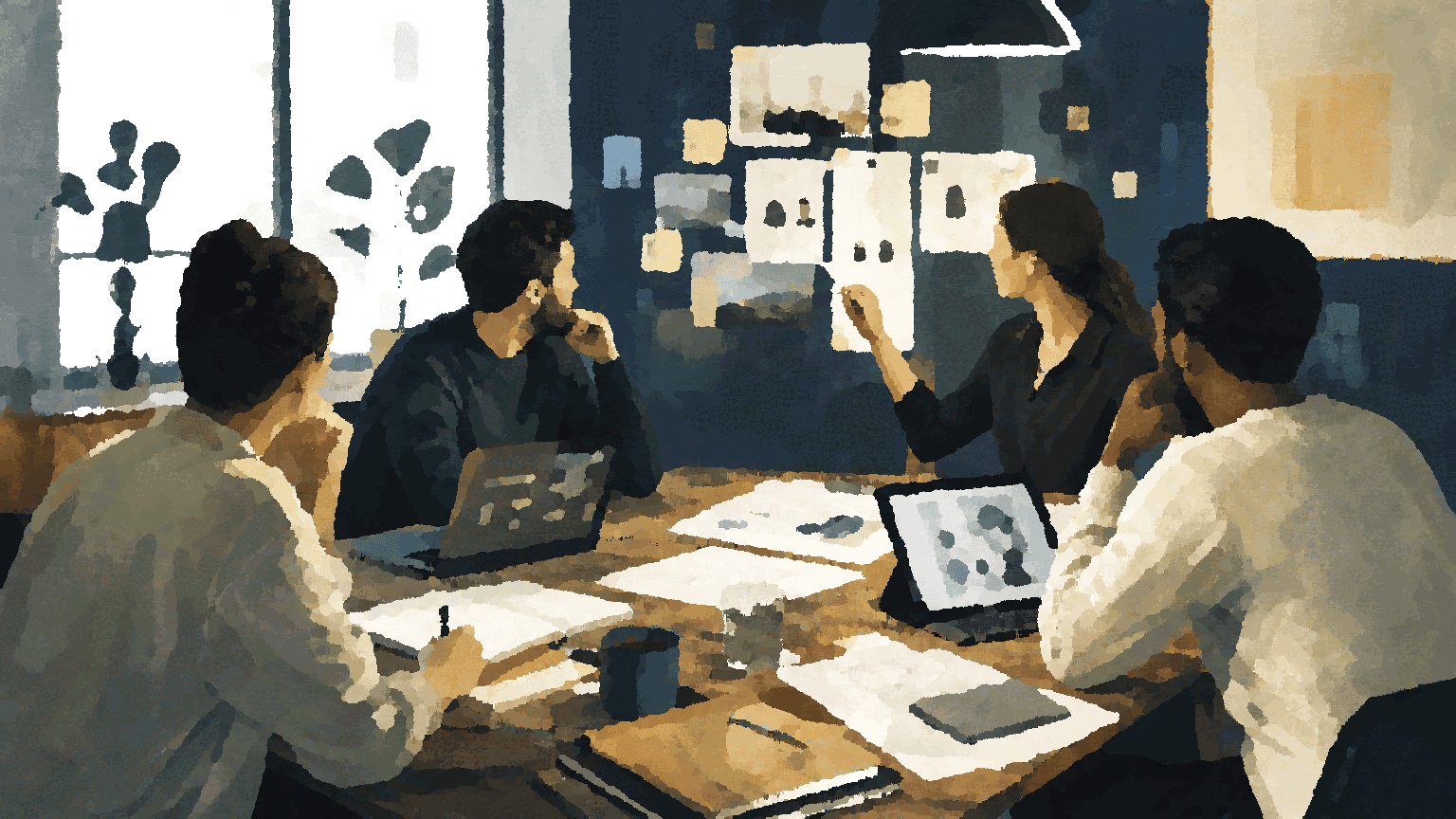
Conversations are where intelligence becomes real.
Human beings have extraordinary conversations all the time: in cars, at dinner, on walks, after meetings, in text threads, in voice notes, and in the strange windows when honesty finally slips through.
Then most of those conversations vanish.
A few fragments remain. A phrase. A feeling. A rough conclusion. Maybe a note scribbled somewhere. Maybe a promise to “circle back.”
But the actual intelligence of the conversation disappears.
Because conversation is where humans do some of their best thinking. Not polished thinking. Generative thinking. The kind where one person’s uncertainty unlocks another person’s insight, or a half-formed thought becomes a plan.
We have built endless tools for storing documents.
We have built far fewer tools for preserving the living intelligence that creates them.
A better collaboration system would treat conversation not as disposable chatter, but as the raw material of decisions, alignment, creativity, and trust.
The interface still has to become human.
In a shared conversation, AI can be useful while the interface still feels awkward.
A phone app is not a natural conversational environment for multiple humans in motion. Someone holds the device. Someone manages the microphone. Someone waits while the AI speaks. Someone gets interrupted. The network glitches. The rhythm breaks.
The technology is close, but the interface can still feel like a solo tool borrowed for a shared human moment.
That is why the interface has to make invitation and control obvious.
Maybe that eventually includes a simple physical control. Maybe it does not. The product point is not the button.
The point is agency.
In human conversation, timing matters. Interruptions matter. Turn-taking matters. Silence matters. Control matters. A shared AI environment cannot feel like a voice assistant randomly entering the room. It has to feel invited, bounded, dismissible, and useful.
The interface needs to make the boundary visible: when AI is invited in, what it is listening to, what it remembers, what it can prepare, and where it must stop.
AI collaboration will not be won only by better models.
It will also be won by better social design.
Who gets to speak? Who gets to approve? What is remembered? What becomes an action? What remains private? What thread are we in? Who is this helping? What is the boundary?
These are not technical details.
They are the architecture of trust.
From talk to traction
There is a rhythm to real human work.
Sometimes we lean back: talk, wander, vent, wonder, dream, complain, imagine.
Sometimes we lean forward: decide, write, assign, build, send, commit, follow through.
Most tools are built for one mode or the other. Chat is lean back. Documents are lean forward. Meetings are often neither. Project tools assume everything is already clear. AI assistants usually wait outside the workflow.
But the most valuable work happens in the transition.
The moment when a messy conversation becomes a plan, a concern becomes a decision, a disagreement becomes a model, or a scattered set of thoughts becomes a shared direction.
That transition is where teams lose enormous value.
It is also where AI can help most.
Not by replacing the humans, but by helping them cross the bridge from talk to traction.
In the car example, the conversation begins as a swirl: life, money, cities, ambition, exhaustion, opportunity. Within minutes, it has shape: categories, tradeoffs, next questions, and a sense of what matters.
That is the multiplier: not “AI wrote a paragraph faster,” but two humans thinking across a life-sized problem without collapsing under its complexity.
Continuity must be permissioned.
For years, people have talked about building a second brain: one person’s notes, links, ideas, and reminders.
Useful, yes.
But incomplete.
The most important intelligence in a company does not belong to one person. It lives between people: the argument between product and sales, the founder’s instinct and the customer’s objection, the engineer’s concern and the designer’s counterpoint, the board meeting, and the late-night debate about whether the company should keep going.
The next step is not just a second brain for individuals.
It is shared context for groups, with human judgment still at the center.
That phrase can sound dangerous if misunderstood. So let us be clear: it should not mean surveillance. It should not mean every private thought is captured, scored, analyzed, and made available to whoever has admin privileges.
That would be dystopian nonsense.
Shared intelligence must be permissioned, contextual, bounded, private where needed, and governed by human authority.
It must know the difference between a thought, a draft, a decision, and a commitment.
But when designed responsibly, permissioned continuity becomes extraordinary.
A team can return to an old thread and remember the reasoning. A founder can branch a conversation into investor strategy. A household conversation can revisit logistics without starting from zero. An advisor can enter the right context. An AI participant can help compare options because it has the chosen context for what the humans already care about.
The value is not memory for memory’s sake.
The value is continuity.

What this means for shared AI work
This is the gap the next generation of collaboration tools has to close.
Not another chatbot.
Not another private productivity hack.
Not another place where useful conversations go to die in a scrollback archive.
A serious workspace for human-AI collaboration would give people and AI participants a shared environment where they can work from the same context, shape durable outputs, and prepare bounded follow-through with visible human authority.
The vision has to be earned in smaller proofs. Serious products earn their way forward.
But the direction is clear: conversations should not vanish by default, and they should not be captured without permission. The right workspace gives people control over what carries forward.
The car ride is a small illustrative example, but small examples are often where the truth shows up first.
A conversation begins in motion. It branches into threads: location research, startup ecosystem strategy, home logistics, investor readiness, a written artifact, a decision to revisit.
The humans do not have to start over every time. The AI does not have to pretend every question is new.
The workspace should help people choose what carries forward, what becomes a thread, what becomes an artifact, and what stays behind.
That is the real product: not the answer, the continuity.
The conversation is the product
The least interesting version of AI is everyone sitting alone, whispering prompts into machines. The most interesting version is AI helping humans rediscover the power of thinking together.
The car conversation is ordinary by design. That is why it works as an example.
Two people simply have too much life to process and not enough shared structure to process it.
AI helps.
That is the point.
This is one of the insights, partly inspired by real events, that explains why I am building Sociail.
I do not think the future of AI collaboration is one person prompting one assistant in one private tab. I think the more important shift is toward people and AI participants working together in shared rooms where context, artifacts, decisions, and approvals can carry forward without turning human work into surveillance.
The goal is not to capture everything.
The goal is to help people preserve the parts of the conversation they choose, turn them into usable work, and return later without losing the thread.
And if it can help there — in emotionally loaded environments where life, money, work, and timing collide — then places like boardrooms, classrooms, studios, and engineering teams will also need better ways to keep human context from fragmenting.
The most important artifact from that car conversation is not a final decision.
It is the restored ability to continue.
But it starts with something fragile: people willing to think out loud together.
For too long, our tools have treated conversation as a temporary input. Something to be mined, summarized, searched, or discarded.
That is backwards.
The conversation is not the prelude to the work.
The conversation is the work beginning to take shape.
When AI can join that conversation respectfully, preserve the chosen context, branch the right threads, and help convert its energy into durable outputs, something changes.
We do not become less human.
We become more available to each other.
That is the product.
Not the chatbot. Not the transcript. Not the summary.
The shared room.
The living context.
The restored ability for people to keep thinking together, with AI in the room.
The next advantage will not belong to the person with the most prompts.
It will belong to the people who can build shared intelligence together, without losing the thread.